


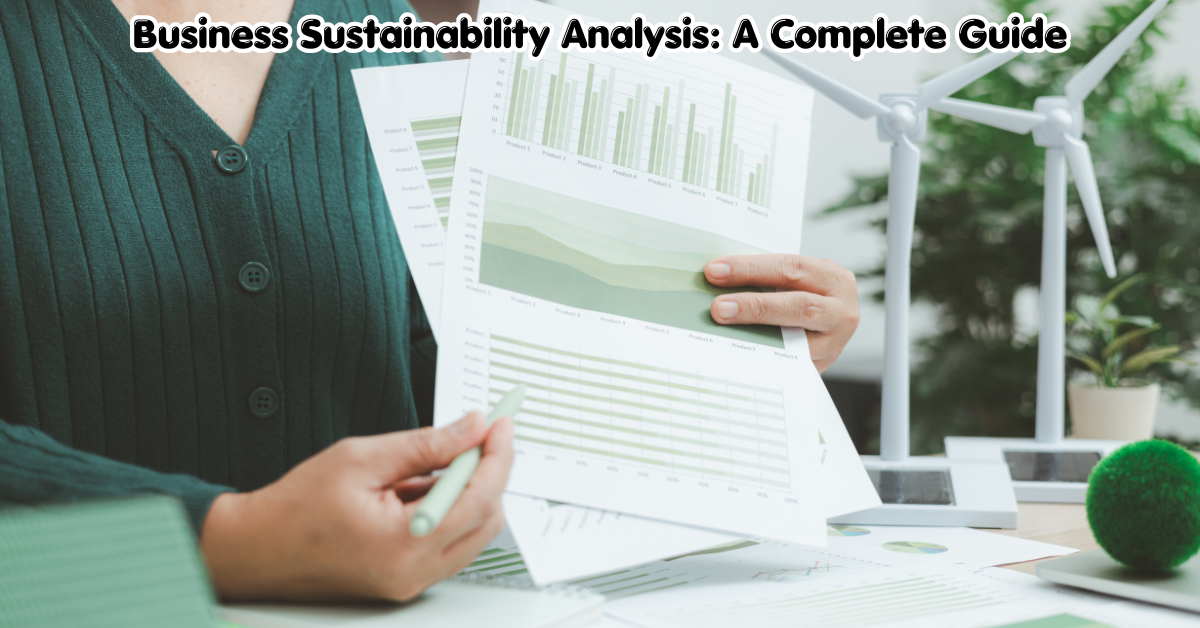
Businesses today are expected to do more than make a profit. They also need to manage resources responsibly, support employees and communities, reduce environmental harm, and remain financially strong over the long term. This is where Business Sustainability Analysis becomes important.
Business sustainability analysis is a structured way to examine how well a company can maintain its financial performance while managing its environmental, social, and organizational responsibilities. It helps businesses understand their current position, identify risks, measure performance, and find practical opportunities for improvement.
A sustainability analysis does not mean that a company must become perfect overnight. Instead, it provides a clear picture of where the business stands today and what it can do to become more resilient and responsible.
Research on business sustainability commonly considers economic, environmental, and social dimensions, while broader frameworks also include governance, ethics, risk, performance, and reporting.
This guide explains what business sustainability analysis means, why it matters, what areas businesses should examine, how to perform an analysis, useful metrics, common challenges, and practical examples.
What Is Business Sustainability Analysis?
Business Sustainability Analysis is the process of evaluating whether a business can create and maintain long-term value while considering its economic, environmental, social, and governance impacts.
In simple terms, it answers a basic question:
Can this business remain successful in the long run without creating unnecessary financial, environmental, or social problems?
A traditional business analysis may focus heavily on revenue, costs, profits, and market growth. Sustainability analysis takes a wider view.
For example, a manufacturing company may be profitable today, but if it depends on an expensive resource that is becoming scarce, faces increasing environmental risks, or has high employee turnover, its long-term stability could be weaker than its current financial results suggest.
A sustainability analysis brings these factors together so decision-makers can see the bigger picture.
Why Is Business Sustainability Analysis Important?
Sustainability is increasingly connected with business strategy, risk management, operations, and long-term value creation. A business sustainability framework can help organizations integrate sustainability into their strategy and reporting rather than treating it as a separate activity.
1. Helps Identify Long-Term Risks
Businesses face many risks that may not appear in a traditional financial report.
These can include:
- Rising energy costs
- Supply chain disruptions
- Resource shortages
- Environmental regulations
- Employee turnover
- Reputation problems
- Changing customer expectations
- Climate-related risks
Analyzing these issues early can help a company prepare instead of reacting after a problem becomes serious.
2. Supports Better Business Decisions
A sustainability analysis gives managers more information when deciding where to invest money, improve operations, introduce technology, or change suppliers.
Instead of asking only whether an option is profitable today, decision-makers can also consider its long-term impact.
3. Improves Resource Efficiency
Businesses use energy, water, raw materials, employee time, transportation, and other resources.
Sustainability analysis can reveal where resources are being wasted.
Reducing waste can sometimes benefit both the environment and the company’s financial performance.
4. Strengthens Business Resilience
A sustainable business is better prepared to deal with changing market conditions.
For example, a company with multiple reliable suppliers may be more resilient than one that depends entirely on a single supplier.
5. Builds Stakeholder Trust
Employees, customers, investors, suppliers, regulators, and communities can all be affected by business decisions.
A broader sustainability approach considers these stakeholders rather than focusing only on short-term shareholder returns.
Main Areas of Business Sustainability Analysis
A complete analysis should examine several interconnected areas.
Economic Sustainability
Economic sustainability focuses on whether the business can remain financially healthy over time.
Important areas include:
- Revenue growth
- Profitability
- Cash flow
- Operating costs
- Productivity
- Financial risk
- Investment capacity
- Long-term competitiveness
A company cannot remain sustainable if it continuously loses money, regardless of how strong its environmental or social programs are.
The goal is to create a business model that can support responsible practices while remaining financially viable.
Environmental Sustainability
Environmental analysis examines how business activities affect the natural environment.
Common areas include:
- Energy consumption
- Greenhouse gas emissions
- Water use
- Waste generation
- Raw material consumption
- Pollution
- Packaging
- Transportation
- Recycling
- Resource efficiency
A company might discover, for example, that replacing inefficient equipment could reduce both energy consumption and operating costs.
Social Sustainability
Social sustainability focuses on people.
This can include:
- Employee health and safety
- Fair treatment
- Employee development
- Working conditions
- Diversity and inclusion
- Customer well-being
- Community relationships
- Human rights
- Supplier labor practices
A company with high employee turnover may need to examine workplace conditions, compensation, management practices, training, or career opportunities.
Governance and Ethics
Governance examines how the company is managed and controlled.
Important areas include:
- Leadership accountability
- Business ethics
- Transparency
- Risk management
- Compliance
- Data protection
- Anti-corruption controls
- Internal policies
- Board oversight
Good governance helps ensure that sustainability commitments are connected to actual business decisions.
Some business sustainability frameworks specifically connect governance and management with sustainability performance, reporting, and assurance.
How to Perform a Business Sustainability Analysis
A useful analysis should follow a logical process.
Step 1: Define the Purpose
Start by deciding why you are conducting the analysis.
Your objective might be to:
- Reduce operating costs
- Improve environmental performance
- Reduce business risks
- Improve supply chain resilience
- Meet sustainability expectations
- Improve employee retention
- Prepare for future regulations
- Strengthen long-term competitiveness
A clear purpose makes the analysis easier to manage.
Step 2: Understand the Current Business Model
Before measuring sustainability, understand how the company currently operates.
Review:
- Products and services
- Customers
- Suppliers
- Revenue sources
- Major expenses
- Key resources
- Employees
- Production activities
- Distribution channels
- Technology systems
This creates a baseline for the analysis.
Step 3: Identify Important Stakeholders
Different stakeholders may have different expectations.
For example:
Customers may care about product quality, safety, and responsible sourcing.
Employees may care about fair treatment, compensation, safety, and career development.
Investors may focus on financial performance, risk, and long-term value.
Communities may care about pollution, employment, and local impacts.
Identifying these expectations helps a business decide which sustainability issues deserve the most attention.
Step 4: Identify Material Sustainability Issues
Not every sustainability issue has the same importance for every company.
A software company may have different priorities from a mining company.
A useful analysis therefore focuses on issues that have a meaningful impact on the business and its stakeholders.
Possible material issues include:
- Energy use
- Supply chain risk
- Employee safety
- Data security
- Water consumption
- Waste
- Product safety
- Business ethics
- Customer privacy
Step 5: Collect Reliable Data
Good decisions require reliable information.
Depending on the company, useful data may include:
- Energy consumption
- Water usage
- Waste volume
- Emissions
- Employee turnover
- Workplace incidents
- Training hours
- Supplier performance
- Operating costs
- Revenue
- Customer complaints
Where possible, use consistent measurements so performance can be compared over time.
Step 6: Measure Current Performance
Create a baseline using relevant sustainability indicators.
For example:
| Area | Example Metric |
| Economic | Profit margin |
| Environmental | Energy use per unit |
| Social | Employee turnover |
| Governance | Compliance incidents |
| Supply Chain | Supplier assessment rate |
The exact indicators should match the company’s industry and goals.
Research reviewing business sustainability assessment approaches has identified several broad methods, including established guidelines, normative frameworks, management systems, index systems, and rating or ranking approaches.
Step 7: Identify Risks and Gaps
Compare current performance with the desired position.
For example:
Current situation: High electricity consumption
Desired situation: Lower energy use per unit of production
Gap: Old equipment and inefficient operating schedules
Possible solution: Upgrade equipment and improve energy management
This makes sustainability improvement more practical.
Step 8: Prioritize Actions
Do not try to solve every issue at once.
Prioritize opportunities according to factors such as:
- Business impact
- Cost
- Risk reduction
- Stakeholder importance
- Feasibility
- Time required
- Expected return
A low-cost improvement with a major business benefit may deserve attention before an expensive long-term project.
Step 9: Create an Action Plan
Turn findings into specific actions.
An action plan should explain:
- What needs to change
- Who is responsible
- What resources are needed
- When the action should be completed
- How success will be measured
This prevents sustainability analysis from becoming only a report with no practical outcome.
Step 10: Monitor and Review
Sustainability is not a one-time project.
Businesses should regularly review their performance and update their goals as circumstances change.
New technologies, regulations, customer expectations, market conditions, and supply chain risks can all change sustainability priorities.
Business Sustainability Analysis Example
Consider a fictional clothing manufacturer.
The company is profitable but has several concerns:
- High energy consumption
- Large amounts of packaging waste
- Employee turnover
- Dependence on one major supplier
- Increasing transportation costs
The company conducts a sustainability analysis.
Economic Findings
Transportation and energy expenses are increasing.
Environmental Findings
Production facilities use older equipment and generate significant packaging waste.
Social Findings
Employee turnover is high in one production facility.
Supply Chain Findings
The company depends heavily on a single supplier for an important material.
The business then creates an improvement plan.
It upgrades inefficient equipment, reduces unnecessary packaging, reviews employee working conditions, and develops relationships with additional suppliers.
The result is not simply an environmental improvement. The company may also reduce costs, improve workforce stability, and become more resilient to supply disruptions.
This illustrates why sustainability analysis should be connected to overall business strategy.
Business Sustainability Metrics
Metrics help turn broad sustainability goals into measurable targets.
Financial Metrics
Possible economic indicators include:
- Revenue growth
- Profit margin
- Operating cost
- Cash flow
- Return on investment
- Cost savings
Environmental Metrics
Common environmental indicators include:
- Energy consumption
- Carbon emissions
- Water consumption
- Waste generated
- Recycling rate
- Renewable energy usage
Social Metrics
Possible social indicators include:
- Employee turnover
- Employee engagement
- Training hours
- Workplace injury rate
- Absenteeism
- Customer satisfaction
Governance Metrics
Governance indicators may include:
- Compliance violations
- Ethics training completion
- Reported incidents
- Audit findings
- Policy compliance
- Risk management performance
The right metrics depend on the company’s size, industry, business model, and objectives.
Business Sustainability Analysis vs. Traditional Business Analysis
Although these approaches overlap, their focus is different.
| Traditional Business Analysis | Sustainability Analysis |
| Often focuses on financial performance | Considers financial and broader sustainability performance |
| Emphasizes shorter-term business results | Places greater emphasis on long-term resilience |
| May focus mainly on customers and shareholders | Considers a wider range of stakeholders |
| Examines business operations | Examines operations and their broader impacts |
| Measures financial KPIs | Uses economic, environmental, social, and governance indicators |
This does not mean traditional business analysis is unimportant. Financial health remains a fundamental part of sustainability.
Instead, sustainability analysis expands the decision-making picture.
Common Tools Used for Sustainability Analysis
Different organizations use different tools depending on their needs.
SWOT Analysis
SWOT can help identify sustainability-related:
- Strengths
- Weaknesses
- Opportunities
- Threats
For example, strong recycling infrastructure may be a strength, while high energy use may be a weakness.
Materiality Assessment
A materiality assessment helps identify sustainability issues that are most important to a business and its stakeholders.
Life Cycle Assessment
Life cycle assessment examines environmental impacts across different stages of a product or service.
This can help companies understand impacts beyond their own facilities.
Sustainability Scorecards
A sustainability scorecard can combine several indicators into one management system.
It allows decision-makers to track progress across different areas.
Benchmarking
Benchmarking compares performance with:
- Previous company performance
- Industry averages
- Competitors
- Internal targets
- Recognized standards
The goal is not simply to achieve a high score. The goal is to understand where performance can improve.
Challenges of Business Sustainability Analysis
Sustainability analysis can provide valuable insights, but it also has challenges.
Lack of Reliable Data
Some organizations do not collect sustainability data consistently.
Without reliable data, comparisons can become difficult.
Different Industry Requirements
A sustainability strategy that works for a technology company may not work for a manufacturing or agricultural business.
Industry context matters.
Difficulty Measuring Long-Term Effects
Some sustainability investments may take years to produce measurable results.
Businesses therefore need realistic timeframes.
Conflicting Priorities
A company may face situations where environmental, social, and financial priorities appear to conflict.
Good decision-making requires examining the long-term consequences rather than focusing on only one metric.
Limited Resources
Small businesses may not have dedicated sustainability teams or large budgets.
They can still begin with simple measurements and focus on the issues that matter most to their operations.
How Small Businesses Can Start
Sustainability analysis is not only for large corporations.
A small business can start with a simple process.
First, review major costs and resource use.
Next, identify the biggest environmental and social risks.
Then choose a few measurable indicators.
For example, a small office could track:
- Electricity consumption
- Paper usage
- Employee turnover
- Business travel
- Waste
- Customer complaints
After establishing a baseline, the company can set realistic improvement goals.
Starting small is often better than creating a complicated sustainability program that nobody maintains.
Best Practices for Business Sustainability Analysis
Connect Sustainability With Business Strategy
Sustainability should support real business objectives rather than exist as a separate activity.
Use Measurable Goals
Instead of saying “reduce waste,” define a specific target and timeframe.
Involve Employees
Employees often understand operational problems that may not appear in management reports.
Consider the Entire Value Chain
A company’s sustainability impact may extend beyond its own facilities to suppliers, transportation, customers, and product use.
Balance Short-Term and Long-Term Thinking
Some improvements may provide immediate savings, while others build resilience over several years.
Review the Data Regularly
Regular measurement helps businesses determine whether their actions are actually producing results.
Be Honest About Progress
A credible sustainability strategy should acknowledge weaknesses as well as achievements.
Overstated claims can damage trust.
Frequently Asked Questions
What is Business Sustainability Analysis?
Business Sustainability Analysis is the systematic evaluation of a company’s financial, environmental, social, and governance performance to understand its ability to create long-term value and manage sustainability-related risks.
What are the main components of business sustainability?
The main components commonly include economic, environmental, and social performance. Broader approaches also consider governance, ethics, risk, stakeholders, reporting, and long-term business resilience.
Why is sustainability analysis important for businesses?
It helps companies identify risks, improve resource efficiency, make better long-term decisions, strengthen resilience, and understand the wider effects of their operations.
How do you conduct a sustainability analysis?
Start by defining the objective, understanding the business model, identifying stakeholders and material issues, collecting data, measuring performance, identifying risks and gaps, prioritizing actions, and monitoring results.
What is the difference between sustainability analysis and sustainability reporting?
Sustainability analysis focuses on understanding performance, risks, opportunities, and improvement areas. Sustainability reporting focuses on communicating relevant sustainability information to stakeholders.
Can small businesses perform sustainability analysis?
Yes. Small businesses can start with a few practical indicators such as energy use, waste, employee turnover, operating costs, and customer satisfaction.
What sustainability metrics should a company track?
There is no universal list for every company. Common metrics include energy use, emissions, waste, water consumption, employee turnover, workplace safety, financial performance, compliance, and customer satisfaction.
Is business sustainability only about the environment?
No. Environmental performance is important, but business sustainability also includes economic health, social responsibility, governance, risk management, and long-term resilience.
Final Thoughts
Business Sustainability Analysis helps organizations look beyond short-term results and understand what is needed for long-term success.
A strong analysis considers the financial health of the business alongside environmental, social, governance, operational, and stakeholder factors. It uses measurable information to identify risks, understand weaknesses, and discover opportunities for improvement.
There is no single sustainability assessment method that is perfect for every organization. Research has found a wide range of approaches and tools, with environmental, social, and economic dimensions appearing frequently in business sustainability assessments.
The best approach is therefore the one that fits the company’s industry, size, objectives, risks, and available data.
Most importantly, sustainability analysis should lead to action. Once a company understands its current position, it can set realistic goals, assign responsibility, measure progress, and continuously improve.
That turns sustainability from a general business idea into a practical part of long-term business strategy.
