



Starbucks business model explained starts with a simple idea: sell coffee while building a strong customer relationship that encourages frequent visits, higher spending, and long-term loyalty. Starbucks combines company-operated stores, licensed locations, beverages, food, packaged products, digital ordering, loyalty programs, and strategic partnerships to create multiple revenue streams.
Understanding this model is useful for entrepreneurs, SaaS professionals, marketers, investors, and students who want to see how a global brand turns a relatively simple product into a scalable business. For broader company and business-model research, readers can also explore business research and company analysis resources.
The Starbucks approach is especially interesting because the company does not compete only on coffee. Its model is built around convenience, brand experience, product innovation, customer retention, store locations, and digital engagement. These elements work together to support both revenue generation and customer loyalty.
What Is the Starbucks Business Model Explained Simply?
The Starbucks business model explained simply is a combination of retail sales, company-operated stores, licensed stores, consumer packaged products, digital channels, loyalty, and partnerships.
The company earns money primarily when customers purchase beverages, food, merchandise, and other products through its retail network and related channels. Licensed stores provide another important stream because partners operate Starbucks locations while the brand can earn revenue through licensing arrangements and product supply.
The model can be summarized through several connected components:
- Company-operated stores: Starbucks directly manages many locations and receives customer sales.
- Licensed stores: Business partners operate Starbucks locations under licensing arrangements.
- Beverages: Coffee, espresso drinks, teas, refreshers, and other beverages are central products.
- Food: Breakfast items, bakery products, snacks, and other food products increase transaction value.
- Packaged products: Starbucks-branded coffee and ready-to-drink products extend the brand beyond its cafés.
- Digital ordering: Mobile ordering and digital payment make purchasing more convenient.
- Loyalty: Rewards encourage customers to return and interact with the brand more frequently.
- Partnerships: Strategic relationships help Starbucks reach customers through channels beyond traditional cafés.
This combination makes Starbucks more than a conventional coffee shop. It operates as a consumer brand with a large physical and digital ecosystem.
How Does Starbucks Business Model Explained Generate Revenue?
Starbucks business model explained through its revenue streams shows why the company can monetize the same customer relationship in multiple ways.
Company-operated stores
Company-operated stores are a major part of the business because Starbucks controls the customer experience, menu, pricing, store environment, and service standards.
When customers buy a latte, cold beverage, breakfast item, or snack, the company records retail revenue from the transaction. Store-level economics depend on factors such as sales volume, product mix, labor costs, rent, utilities, ingredients, and operating efficiency.
The advantage is greater control. Starbucks can test products, introduce promotions, collect customer feedback, and manage the experience directly.
Licensed stores
Licensed locations provide a different growth mechanism. Instead of Starbucks funding and operating every store itself, another organization can operate a location under the Starbucks brand.
This structure can help the company expand its presence while reducing some of the direct operating responsibilities associated with company-operated stores. Licensed partners can also provide access to locations such as airports, universities, hotels, hospitals, and other high-traffic environments.
Consumer products and partnerships
Starbucks also extends its brand into grocery stores and other consumer channels through packaged coffee and ready-to-drink products. Partnerships can allow customers to encounter Starbucks products outside traditional cafés.
This is strategically valuable because the customer does not need to physically visit a Starbucks store for the brand to generate sales.
Starbucks Business Model Explained Through Customer Loyalty

A major strength of the Starbucks business model explained from a customer perspective is its focus on repeat purchases.
Coffee is naturally suited to recurring consumption. A customer may purchase coffee several times a week, making retention especially valuable. Starbucks attempts to turn occasional customers into habitual customers through convenience, personalization, rewards, and digital engagement.
Starbucks Rewards
The loyalty program encourages customers to interact with the brand repeatedly. Customers can earn rewards and receive a more personalized experience through the company’s digital ecosystem.
For a business, loyalty can be valuable because acquiring a new customer may require more effort than encouraging an existing customer to make another purchase.
Mobile ordering and payments
The Starbucks mobile experience supports ordering, payment, account management, and rewards. Mobile ordering can reduce friction by allowing customers to place orders before arriving at a store.
This is an important lesson for SaaS businesses. A strong digital product does not always need to be the primary source of revenue. It can also improve the performance of an existing physical business.
Starbucks Business Model Explained Using the Store Experience
Starbucks business model explained through its stores reveals another important competitive factor: the company sells an experience alongside the product.
The store environment, branding, menu presentation, packaging, music, seating, service, and customer interaction all contribute to the perceived value of the purchase.
A customer is therefore not simply paying for coffee beans, milk, water, and flavoring. The purchase can also represent convenience, familiarity, personalization, atmosphere, and brand identity.
This approach helps explain why Starbucks has historically been able to position many products above basic commodity coffee.
Location strategy
Location is another important part of the model. Stores need sufficient customer traffic to support sales while maintaining manageable occupancy and operating costs.
High-traffic areas can provide strong visibility and convenience, but they can also involve higher costs. The challenge is finding locations where customer demand and store economics work together.
For businesses in markets such as India, this provides a useful lesson: expansion should not be based only on the number of locations. Store productivity, customer behavior, local competition, purchasing power, and operating costs also matter.
Why Does Starbucks Use Multiple Business Channels?
Starbucks business model explained from a strategic perspective is based on diversification within the same brand ecosystem.
The company can reach customers through cafés, licensed locations, grocery products, ready-to-drink beverages, digital platforms, and partnerships. Each channel serves a slightly different customer need.
For example, someone might purchase a Starbucks beverage during a morning commute, prepare Starbucks packaged coffee at home, or buy a ready-to-drink product from a retail outlet.
The benefit is greater brand reach without relying entirely on one purchasing environment.
This strategy is particularly relevant to SaaS companies. A SaaS business can similarly build multiple connected revenue channels through subscriptions, add-ons, enterprise plans, integrations, marketplaces, and partner distribution.
What Makes Starbucks Pricing Strategy Effective?
Pricing is another important part of Starbucks business model explained through its value proposition.
Starbucks does not need to compete solely on being the cheapest coffee provider. Instead, it can use brand strength, convenience, product variety, customization, and customer experience to support its pricing position.
Menu architecture also matters. Customers can choose products at different price points, while customization can increase the final transaction value.
Product customization
Customers can modify beverages through size, milk choices, flavors, toppings, and other options. Customization creates a more personalized purchase and can provide opportunities for higher-value transactions.
Premium product perception
Limited-time beverages, seasonal offerings, specialty drinks, and new product launches can create customer interest and encourage experimentation.
However, premium pricing has limitations. If customers believe prices are rising faster than perceived value, they may reduce purchase frequency or switch to alternatives.
Starbucks Business Model Explained Through Technology
Technology plays an important supporting role in Starbucks business model explained because digital tools connect customers, stores, payments, loyalty, and purchasing behavior.
The technology layer can improve convenience while giving the company a stronger understanding of customer interactions.
Key technology-enabled areas include:
- Mobile ordering
- Digital payments
- Loyalty management
- Personalized offers
- Customer account management
- Store order management
- Digital communication
- Data-supported product and marketing decisions
For SaaS professionals, Starbucks provides an interesting example of how software can become a strategic layer around a traditional business.
The software does not replace the café. Instead, it makes the café easier to access and helps create a more connected customer journey.
What Are the Main Costs in the Starbucks Business Model?
Revenue is only one side of the equation. Starbucks must manage significant operating expenses to maintain its store network and customer experience.
Major cost categories can include:
- Employee wages and benefits
- Store rent and occupancy
- Coffee and other ingredients
- Packaging
- Equipment
- Utilities
- Logistics and distribution
- Technology
- Marketing
- Store maintenance
- Administrative expenses
Company-operated stores provide control but also expose Starbucks directly to these operating costs.
Licensed stores can change the economics because the partner carries more of the store-level operating responsibility. This illustrates why Starbucks uses different operating formats rather than relying on a single model.
How Starbucks Builds a Competitive Advantage
The Starbucks business model explained through competitive advantage is based on several reinforcing assets rather than one feature.
Brand recognition
A recognizable global brand can reduce the uncertainty customers feel when choosing where to purchase coffee.
Customer habits
Frequent purchasing can create strong customer routines. Once a customer becomes accustomed to a particular store, beverage, mobile app, or rewards system, convenience can encourage continued use.
Network effect of locations
A broad store network can make the brand easier to access. Customers may encounter Starbucks while traveling, shopping, working, studying, or commuting.
Digital ecosystem
The combination of loyalty, mobile ordering, payment, and customer accounts creates a digital relationship around physical retail.
Product innovation
New beverages and seasonal products can keep the menu interesting and provide reasons for customers to return.
Starbucks Business Model Explained for the Indian Market
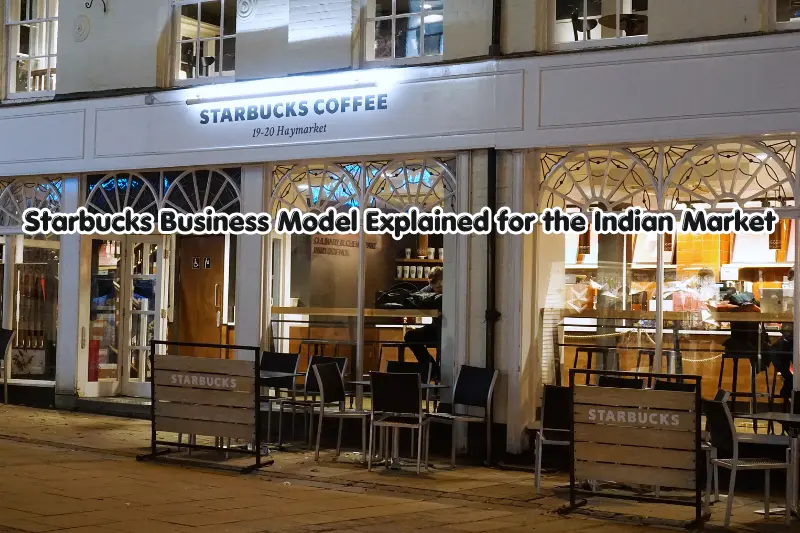
For readers in India, Starbucks offers useful lessons about localization and premium positioning.
India has a diverse consumer market with major differences in income, lifestyle, geography, food preferences, and purchasing behavior. A global coffee brand therefore needs to balance international consistency with local relevance.
Starbucks’ presence in India also demonstrates how international brands can use partnerships and local market knowledge when entering a large and complex market.
For Indian SaaS companies, the broader lesson is equally useful: a successful global model cannot always be copied without adaptation. Pricing, distribution, customer support, payment methods, product design, and marketing often need to reflect local market conditions.
What Are the Limitations of the Starbucks Business Model?
No business model is risk-free. Starbucks faces challenges associated with labor expenses, store costs, competition, changing consumer preferences, supply-chain pressures, economic conditions, and maintaining consistent customer experiences across a large network.
Heavy reliance on physical stores also means that location economics matter significantly.
The brand must continually balance growth with store productivity. Opening more locations can increase market reach, but poor locations or weak demand can negatively affect overall performance.
Digital ordering also creates operational challenges. A high volume of mobile orders can place pressure on store workflows if staffing, equipment, and order management are not properly aligned.
Common Business Lessons From Starbucks
Starbucks business model explained as a business case offers several lessons that SaaS founders and marketers can apply.
Build recurring behavior: Products become more valuable when customers have a reason to return regularly.
Create multiple revenue opportunities: A strong core product can support related products, services, partnerships, and distribution channels.
Use technology to reduce friction: Digital tools should make purchasing, communication, and customer management easier.
Protect the brand experience: Consistency can strengthen customer trust.
Measure unit economics: Growth in locations, users, or customers is not enough if individual units are not economically sustainable.
Localize intelligently: A global strategy should allow room for local market conditions and customer preferences.
Common Mistakes When Analyzing Starbucks Business Model Explained
One common mistake is assuming Starbucks makes money only from selling coffee. Its broader ecosystem includes stores, licensed operations, consumer products, digital engagement, and partnerships.
Another mistake is focusing only on revenue while ignoring costs. A business can generate substantial sales but still face pressure if labor, rent, supply, and operating expenses rise.
A third mistake is treating the loyalty program as simply a discount mechanism. Its broader strategic value comes from encouraging repeat engagement and connecting customers with the digital ecosystem.
Finally, businesses should avoid copying Starbucks without understanding the underlying principle. The goal is not to create a coffee shop. The goal is to build a repeatable customer journey where product, brand, convenience, technology, and distribution reinforce one another.
Safety, Compliance, and Operational Considerations
Although Starbucks is primarily a retail and food-service business, operational safety remains essential. Equipment, electrical systems, food handling, workplace procedures, delivery activities, and building operations all require appropriate controls.
For businesses that operate vehicles as part of logistics or delivery activities, roadworthiness and transport safety should also be treated seriously. Official transport guidance such as the Waka Kotahi NZ Transport Agency can provide useful reference material for relevant road-safety and transport requirements.
The precise requirements vary by country and operation, so businesses should rely on applicable local regulations rather than assuming that one country’s rules apply everywhere.
How SaaS Companies Can Learn From Starbucks
Starbucks business model explained from a SaaS perspective demonstrates that customer experience and technology can work together without being the same product.
A SaaS company can apply similar principles by creating a strong core product, encouraging recurring usage, developing loyalty mechanisms, improving onboarding, introducing complementary products, and using partnerships to expand distribution.
For example, a SaaS platform might start with one subscription product and later add premium plans, integrations, usage-based features, enterprise services, partner channels, or marketplace distribution.
The important principle is strategic alignment. Every additional channel should strengthen the core customer relationship instead of creating unnecessary complexity.
Frequently Asked Questions
What is Starbucks business model explained in simple terms?
Starbucks business model explained simply is a multi-channel retail model centered on beverages and food, supported by company-operated stores, licensed locations, packaged products, digital ordering, loyalty, and partnerships. Starbucks combines physical retail with technology and brand-building to encourage repeat purchases and extend its reach beyond cafés.
What are the most common Starbucks business model revenue streams?
The major revenue sources include sales from company-operated stores, licensed-store activities, beverages, food, merchandise, packaged coffee, and other consumer products. Digital channels and strategic partnerships support the broader ecosystem. The exact contribution of individual streams can change over time as store formats, consumer products, and market strategies evolve.
How does Starbucks use technology in its business model?
Starbucks uses technology to connect mobile ordering, payments, loyalty, customer accounts, personalization, and store operations. These tools reduce purchasing friction and encourage repeat engagement. The technology layer also gives the business a stronger way to manage the relationship between customers and physical stores.
Why can Starbucks customers experience power loss or warning lights in related business operations?
If a business operates delivery or support vehicles, power loss or engine warning lights are separate vehicle-maintenance issues rather than core Starbucks business-model features. Such symptoms can indicate fuel, electrical, sensor, turbocharger, or engine problems and should be assessed using appropriate vehicle diagnostics rather than guessing at the cause.
Why is professional business-model analysis useful?
Professional analysis helps separate revenue, costs, customer acquisition, retention, distribution, and operational risks. Starbucks business model explained in this way shows how individual components support one another. For entrepreneurs and SaaS teams, this makes it easier to identify transferable principles without copying a business model blindly.
Conclusion
Starbucks business model explained shows how a company can transform a familiar product into a broader customer ecosystem through stores, licensing, food, packaged products, technology, loyalty, partnerships, and brand experience. Its strength comes from connecting these components rather than depending on coffee sales alone.
For SaaS businesses, the most valuable lessons are recurring customer behavior, frictionless digital experiences, diversified channels, strong branding, localization, and disciplined unit economics. Accurate analysis should consider both revenue opportunities and operating costs before judging the model’s success.
For further company and business-model research, visit Truck Mechanic Levin and business research resources.
