


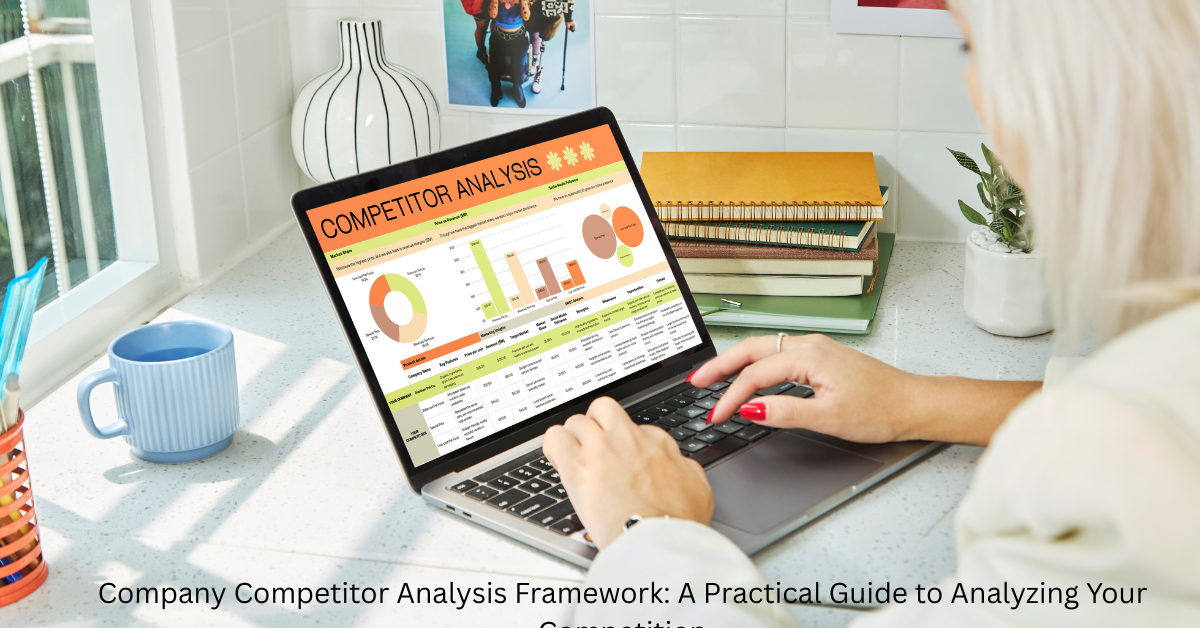
Company Competitor Analysis Framework is a structured method businesses use to identify competitors, compare their strengths and weaknesses, understand market positioning, and discover opportunities for growth. Instead of relying on assumptions, a good competitor analysis framework organizes market information into clear categories that support better business decisions.
For companies operating in India, competitor analysis can be especially useful when entering a new market, launching a product, improving pricing, developing marketing campaigns, or trying to differentiate from established competitors. This guide explains how to build and use a practical company competitor analysis framework, what information to collect, which metrics matter, common mistakes to avoid, and how to turn research into an actionable strategy.
What Is a Company Competitor Analysis Framework?
A company competitor analysis framework is a repeatable process for evaluating competing businesses based on factors such as products, pricing, customers, marketing, positioning, strengths, weaknesses, and market presence.
The purpose is not simply to copy competitors. The goal is to understand why customers choose them, where they perform well, where they have gaps, and where your company can create a stronger value proposition.
A useful framework usually examines:
- Direct competitors
- Indirect competitors
- Products and services
- Pricing and offers
- Target customers
- Brand positioning
- Website and SEO
- Content marketing
- Social media
- Customer experience
- Strengths and weaknesses
- Market opportunities
- Competitive threats
The information can then be organized into a competitor matrix or comparison table so that patterns become easier to identify.
Why Is Competitor Analysis Important for a Company?
Competitor analysis helps a company make decisions using market evidence instead of assumptions. It can reveal customer expectations, competitive gaps, pricing patterns, marketing opportunities, and areas where competitors are stronger or weaker.
For example, imagine an Indian company selling business software. Its competitors may have similar features, but one competitor could offer better customer support, another could have a simpler pricing model, and another could dominate Google search results.
Without competitor research, the company may focus entirely on adding more features. With competitor analysis, it may discover that ease of use, transparent pricing, and responsive support provide a better opportunity for differentiation.
Key Benefits of Competitor Analysis
A strong competitor analysis can help businesses:
- Identify market opportunities
- Understand competitor positioning
- Improve products and services
- Develop better pricing strategies
- Find content gaps
- Improve SEO performance
- Understand customer expectations
- Strengthen marketing campaigns
- Identify competitive threats
- Build a clearer unique value proposition
The biggest benefit is better decision-making. Competitor research gives management a clearer picture of the environment in which the company operates.
Company Competitor Analysis Framework: The Core Components
A practical framework should cover the areas that directly influence customer decisions and business performance.
1. Identify Your Competitors
The first step is creating a realistic competitor list.
Start with direct competitors. These companies offer similar products or services to the same target customers.
Then identify indirect competitors. These businesses solve the same customer problem through a different product, service, or approach.
For example, a traditional accounting firm and accounting software may compete indirectly because both help businesses manage accounting needs.
Your competitor list can include:
- Local competitors
- National competitors
- International competitors
- Online competitors
- Emerging startups
- Established market leaders
- Substitute products or services
Do not automatically assume that the largest companies are your most important competitors. A smaller company with strong SEO, pricing, customer reviews, or a highly focused niche can also influence your market.
2. Analyze Products and Services
Compare what each competitor actually provides.
Look at the core product or service first. Then examine additional features, packages, guarantees, customer support, customization, integrations, and after-sales service.
Ask:
- What does the competitor sell?
- Which products are most popular?
- What features are included?
- What problems does the product solve?
- What makes the product different?
- Does the company offer customization?
- What support is available?
- What limitations do customers mention?
The objective is to understand the competitor’s complete customer proposition rather than comparing one feature in isolation.
3. Compare Pricing Strategies
Pricing is one of the most important elements of competitor research.
Record publicly available pricing whenever possible and note whether competitors use:
- Subscription pricing
- One-time payments
- Freemium models
- Tiered plans
- Custom quotations
- Discounts
- Introductory offers
- Bundled packages
- Premium pricing
Do not automatically conclude that the lowest price is the strongest strategy.
A competitor charging more may justify the price through better service, stronger branding, advanced features, warranties, or specialist expertise.
For Indian businesses, pricing should also be evaluated against the purchasing power and expectations of the specific customer segment rather than the entire market.
4. Study Target Customers
Understanding who buys from competitors can reveal opportunities for your own company.
Research the competitor’s apparent customer segments and identify whether they primarily serve:
- Consumers
- Small businesses
- Medium-sized businesses
- Enterprises
- Students
- Professionals
- Specific industries
- Specific geographic markets
Then examine customer needs.
Ask what customers appear to value most. Is it affordability, convenience, reliability, speed, quality, technical support, reputation, customization, or something else?
Customer reviews, product pages, FAQs, social discussions, and public feedback can provide useful clues.
5. Analyze Brand Positioning
Brand positioning explains how a company wants customers to perceive it compared with alternatives.
One competitor might position itself as affordable, while another focuses on premium quality. A third might compete through speed, convenience, innovation, or specialist expertise.
Look at:
- Brand messaging
- Taglines
- Value propositions
- Visual identity
- Product descriptions
- Website messaging
- Advertising themes
- Customer promises
Then ask an important question:
What does each competitor appear to want customers to remember about the company?
This helps identify crowded positioning and potential gaps.
6. Evaluate Competitor Websites and SEO
For companies competing online, website and SEO analysis should be an important part of the framework.
Examine competitor websites for:
- Website structure
- Main service pages
- Product pages
- Blog content
- FAQ sections
- Internal linking
- Page titles
- Meta descriptions
- Search intent coverage
- Local landing pages
- Conversion elements
- Calls to action
You can also examine which topics competitors consistently cover.
For example, if several competitors have detailed pages answering customer questions while your website only contains short product descriptions, there may be a content opportunity.
SEO competitor analysis should focus on understanding search intent and content quality, not simply copying keywords.
7. Analyze Content Marketing
Content can reveal a competitor’s marketing priorities.
Review the types of content competitors publish, including:
- Blog posts
- Guides
- Case studies
- White papers
- Videos
- Tutorials
- FAQs
- Comparison pages
- Customer stories
- Industry reports
Look for both strengths and gaps.
A competitor may publish hundreds of articles but provide little practical information. Another may have fewer pages but create highly useful resources.
The opportunity is not necessarily to publish more content. It is to publish better content that satisfies the specific questions and problems of your audience.
8. Examine Social Media and Customer Engagement
Social media analysis can help you understand how competitors communicate with customers.
Consider:
- Platforms used
- Posting frequency
- Content formats
- Engagement patterns
- Promotional campaigns
- Customer responses
- Influencer partnerships
- Educational content
- Community-building activities
Pay particular attention to how competitors respond to customer questions and complaints.
Customer interaction can reveal information that is difficult to discover from a competitor’s website alone.
Competitor Analysis Matrix
A competitor matrix makes research easier to compare.
| Factor | Your Company | Competitor A | Competitor B | Competitor C |
| Product quality | Evaluate | High/Medium/Low | High/Medium/Low | High/Medium/Low |
| Pricing | Evaluate | Compare | Compare | Compare |
| Brand positioning | Define | Analyze | Analyze | Analyze |
| SEO visibility | Measure | Compare | Compare | Compare |
| Content quality | Measure | Compare | Compare | Compare |
| Customer support | Evaluate | Compare | Compare | Compare |
| Product range | Evaluate | Compare | Compare | Compare |
| Key strength | Identify | Identify | Identify | Identify |
| Key weakness | Identify | Identify | Identify | Identify |
The matrix should be based on evidence wherever possible. Avoid assigning ratings simply because a competitor appears successful.
How to Conduct a Company Competitor Analysis Step by Step
Step 1: Define the Objective
Start by deciding why you are performing the analysis.
Your objective might be:
- Entering a new market
- Launching a product
- Improving SEO
- Reviewing pricing
- Increasing sales
- Improving customer experience
- Finding market gaps
A clear objective prevents unnecessary research.
Step 2: Select Relevant Competitors
Choose a manageable group of meaningful competitors.
Include both established companies and emerging businesses when they are relevant to your target market.
Step 3: Collect Consistent Information
Use the same categories for every competitor.
For example, record pricing, product features, positioning, website quality, content, reviews, and customer support for each company.
Consistency makes comparisons more reliable.
Step 4: Identify Patterns
After collecting information, look for recurring patterns.
You may discover that:
- Most competitors target the same customer segment.
- Several competitors use similar pricing.
- A particular feature is common across the market.
- Customers repeatedly complain about one issue.
- Certain questions are poorly answered online.
- Competitors are strong in one area but weak in another.
These patterns can reveal strategic opportunities.
Step 5: Find Competitive Gaps
A competitive gap exists when customers have a need that competitors do not adequately satisfy.
Examples include:
- Poor customer support
- Complicated pricing
- Limited customization
- Weak educational resources
- Slow service
- Poor mobile experience
- Lack of local support
- Confusing product information
The strongest opportunities are usually based on meaningful customer problems rather than superficial differences.
Step 6: Turn Findings Into Actions

Research has limited value if nothing changes afterward.
Create specific actions based on your findings.
For example:
Finding: Competitors have complicated pricing.
Action: Create a simpler pricing structure with clear inclusions.
Finding: Competitors have weak educational content.
Action: Build detailed guides, FAQs, tutorials, and comparison resources.
Finding: Customers complain about slow support.
Action: Improve response processes and clearly communicate support availability.
What Should You Measure in Competitor Analysis?
The right metrics depend on the purpose of the analysis.
For digital businesses, useful indicators may include:
- Organic search visibility
- Ranking keywords
- Website traffic estimates
- Content coverage
- Backlink profiles
- Domain-level SEO indicators
- Conversion-focused pages
- Social engagement
- Customer reviews
For offline businesses, relevant factors may include:
- Location
- Store presence
- Product availability
- Pricing
- Customer service
- Reputation
- Distribution
- Local market coverage
Do not treat any single metric as proof that a competitor is better. Metrics are most useful when evaluated together.
SWOT Analysis Within a Competitor Framework
A SWOT analysis can complement competitor research.
Strengths
Identify areas where your company performs well.
Examples:
- Strong product quality
- Skilled team
- Better customer support
- Strong distribution
- Specialized expertise
Weaknesses
Identify internal limitations.
Examples:
- Limited brand awareness
- Small product range
- Weak online presence
- Higher operating costs
Opportunities
Look for external opportunities.
Examples:
- Underserved customer segments
- Content gaps
- New geographic markets
- Emerging customer needs
Threats
Identify external risks.
Examples:
- Aggressive competitors
- New entrants
- Price competition
- Changing customer preferences
- Substitute products
SWOT is most useful when it leads to specific decisions rather than becoming a simple list of observations.
Common Mistakes in Competitor Analysis
Even a well-designed framework can produce poor results if the research process is weak.
Focusing Only on Large Competitors
Large companies are visible, but smaller competitors can sometimes be more relevant to a specific customer segment.
Copying Competitors
Competitor research should inform strategy, not encourage imitation.
Copying another company’s website, messaging, pricing, or content can weaken differentiation.
Using Outdated Information
Prices, products, campaigns, and positioning can change. Record when research was performed and review important information periodically.
Ignoring Customer Feedback
Businesses sometimes focus heavily on competitor websites while overlooking what customers actually say.
Reviews and public feedback can reveal valuable pain points.
Collecting Too Much Data
More data does not automatically mean better analysis. Focus on information that can influence a business decision.
Confusing Correlation With Causation
A competitor may rank highly on Google and have a large content library, but that does not prove content volume alone caused its success.
Treat observations carefully and avoid unsupported conclusions.
How Often Should a Company Perform Competitor Analysis?
There is no universal schedule.
A company in a rapidly changing market may monitor competitors frequently, while a stable business may conduct a deeper strategic review less often.
A practical approach is to use two levels:
Ongoing monitoring: Track major changes such as new products, pricing, campaigns, and positioning.
Periodic deep analysis: Revisit the full competitor framework when making significant strategic decisions.
The right frequency depends on the industry, competitive intensity, company size, and business objectives.
How Indian Companies Can Use Competitor Analysis Effectively
For companies targeting customers in India, competitor analysis should account for local market differences.
Consider factors such as:
- Regional customer preferences
- Language requirements
- Local purchasing behavior
- Urban and smaller-city markets
- Mobile-first customer experiences
- Local competitors
- Delivery or service coverage
- Payment preferences
- Customer support expectations
A strategy that works for a premium metropolitan audience may not work equally well for customers in other regions.
The objective is to understand your specific Indian target market rather than treating the country as one uniform customer segment.
Tips for Building a Better Competitor Analysis Framework
Use these principles to make your research more useful:
- Start with a clear business question.
- Separate direct and indirect competitors.
- Use consistent comparison criteria.
- Record evidence instead of relying on assumptions.
- Study customer feedback alongside competitor marketing.
- Look for gaps rather than copying strengths.
- Prioritize findings according to business impact.
- Update important information when the market changes.
- Turn every major finding into a possible action.
- Keep the final framework simple enough for decision-makers to use.
Frequently Asked Questions
What is a company competitor analysis framework?
A company competitor analysis framework is a structured system for evaluating competing businesses. It typically compares products, pricing, customers, positioning, marketing, SEO, customer experience, strengths, weaknesses, opportunities, and threats. The framework helps businesses organize market information and use it to make better strategic decisions.
What are the main steps in competitor analysis?
The main steps are defining the research objective, identifying direct and indirect competitors, collecting consistent information, comparing products and pricing, analyzing marketing and customer experience, identifying competitive gaps, and turning findings into specific business actions. The process should focus on information that can influence actual decisions.
Why should companies analyze their competitors?
Companies analyze competitors to understand market expectations, identify opportunities, recognize threats, improve their products, refine pricing, strengthen marketing, and differentiate their brand. Competitor analysis does not replace customer research, but it provides valuable context about the alternatives customers can choose from.
How many competitors should a company analyze?
There is no fixed number that works for every company. A practical analysis should include enough competitors to represent the relevant market without making the research unnecessarily complicated. Start with the most important direct competitors and add indirect or emerging competitors when they could materially affect customer choices.
Is competitor analysis useful for small businesses?
Yes. Small businesses can use competitor analysis to identify underserved customer needs and compete more strategically. Instead of trying to match larger companies in every area, a small business can focus on specific advantages such as personalized service, specialist expertise, local knowledge, convenience, product quality, or a clearly defined niche.
Conclusion: Turn Competitor Research Into a Competitive Advantage
A Company Competitor Analysis Framework gives businesses a practical way to understand the competitive environment and make more informed decisions. The strongest framework does more than list competitors. It examines products, pricing, customers, positioning, SEO, content, customer experience, strengths, weaknesses, opportunities, and threats.
For an Indian company, the analysis should also reflect the specific needs, expectations, geography, and purchasing behavior of its target customers.
The next practical step is simple: choose your top competitors, create a comparison matrix, collect evidence using the same categories, identify three to five meaningful gaps, and turn those gaps into specific actions for your business.
A competitor analysis becomes valuable when it changes what the company does. Research should ultimately lead to clearer positioning, better customer experiences, stronger products, and smarter business decisions.
