


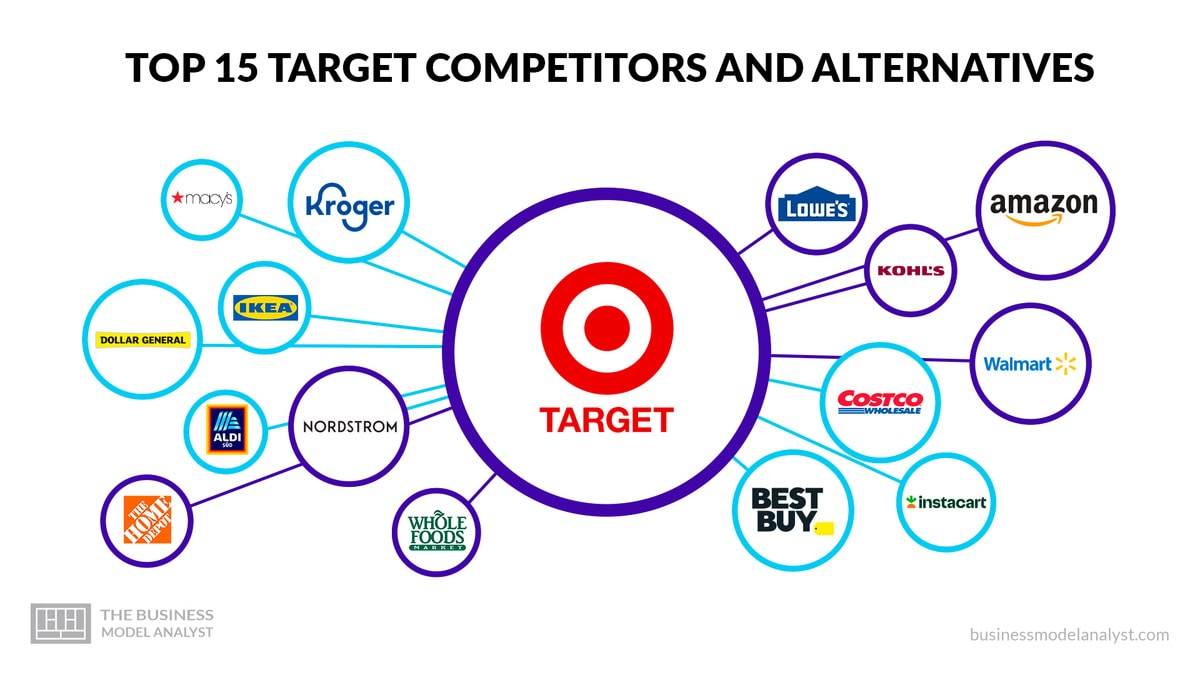
Target Corporation competes with some of the largest retailers in the United States. Its closest competitors include Walmart, Amazon and Costco, while Kroger, Best Buy, department stores and category-specific retailers compete with Target in particular areas.
Each rival challenges Target differently. Walmart competes through scale and low prices, Amazon through online convenience, and Costco through membership value and bulk purchasing. Target seeks to stand apart with a curated assortment, owned brands, attractive stores and fulfilment services connected to its nationwide store network.
This detailed analysis compares the leading Target Corporation competitors across business model, products, pricing, physical presence, e-commerce and customer value.
Target Corporation Competitors at a Glance
| Competitor | Primary competitive area | Main business advantage | How Target differs |
|---|---|---|---|
| Walmart | General merchandise and groceries | Scale, pricing and broad store network | More design-led and curated assortment |
| Amazon | E-commerce and fast delivery | Online selection, technology and Prime | Physical stores and pickup convenience |
| Costco | Value retail and household goods | Membership model and bulk pricing | No paid membership required for basic shopping |
| Kroger | Groceries and household essentials | Strong supermarket presence | Wider discretionary assortment |
| Best Buy | Electronics and appliances | Category expertise and technical services | Broader one-stop shopping selection |
| Department stores | Apparel, beauty and home | Brand selection and fashion categories | Greater focus on everyday value and essentials |
| Dollar stores | Low-priced essentials | Small formats and value positioning | Broader assortment and stronger digital services |
These businesses are not identical to Target. The relevance of each competitor depends on the product category, location and customer need being analyzed.
Who Is Target’s Biggest Competitor?
Walmart is generally Target’s closest direct competitor because both businesses operate large store networks and sell groceries, household essentials, clothing, electronics, toys and home products. Both also combine physical stores with e-commerce, pickup and delivery.
Walmart’s scale is considerably larger. Walmart reported approximately $713 billion in fiscal 2026 revenue, while its U.S. division generated $483 billion in net sales. Target reported $104.780 billion in fiscal 2025 net sales. Their fiscal-year labels refer to periods ending January 31, 2026, but their business scopes and revenue classifications are not identical. Walmart fiscal 2026 Form 10-K, Target fiscal 2025 annual report
Amazon is Target’s strongest digital competitor, while Costco presents a distinct challenge in membership-based value retail. For this reason, there is no single competitor that represents every threat to Target’s business.
Target vs. Walmart
Target and Walmart have substantial overlap in customers and merchandise. Both companies sell food, household products, apparel, beauty products, electronics, toys and home goods through stores and online channels.
Product Selection and Positioning
Walmart emphasizes broad selection and everyday low prices. Its scale allows it to serve many shopping occasions, from routine grocery trips to large online orders.
Target also competes on value but gives greater emphasis to style, design and curated merchandise. Owned brands such as Good & Gather, Cat & Jack, Threshold and A New Day help Target offer products that cannot be directly matched with identical items at Walmart.
Store and E-Commerce Strategy
Both retailers use stores to support digital fulfilment. Customers can order online and choose shipping, pickup or delivery, depending on availability.
Walmart serves approximately 280 million customers and members each week through more than 10,900 stores and numerous e-commerce websites across 19 countries. Target’s retail stores are concentrated in the United States, where it operates more than 2,000 locations. Walmart fiscal 2027 Q1 release, Target locations
Walmart’s larger international presence and revenue base provide significant purchasing and logistics scale. Target’s more concentrated U.S. footprint can support a clearer domestic brand identity, but it also gives the company less geographic diversification.
Target vs. Walmart Summary
| Comparison area | Target | Walmart |
|---|---|---|
| Positioning | Style, design, convenience and value | Broad assortment and low prices |
| Geographic focus | Primarily U.S. retail | Large international presence |
| Store format | General merchandise with groceries | Supercentres and multiple retail formats |
| Key differentiator | Owned brands and curated experience | Scale and price competitiveness |
| Main advantage over the other | More distinctive product presentation | Greater size, reach and purchasing power |
Walmart is the strongest overall direct competitor because it challenges Target across the largest number of categories.
Target vs. Amazon
Amazon competes with Target mainly through e-commerce, extensive product selection, digital technology and delivery. Its business is much broader than retail because it also operates cloud computing, advertising, subscriptions and other services.
Amazon reported total net sales of $716.9 billion in calendar 2025. This included $426.3 billion from its North America segment, $161.9 billion from its international segment and $128.7 billion from Amazon Web Services. These consolidated figures should not be treated as direct retail-only comparisons with Target. Amazon 2025 results
Online Selection and Convenience
Amazon’s major advantage is the breadth of its online marketplace. Customers can compare products across numerous categories and receive many orders quickly through its fulfilment network.
Target offers a smaller and more curated digital assortment. Its advantage is the connection between online shopping and nearby physical stores, allowing customers to use services such as Drive Up and Order Pickup.
Marketplace Models
Amazon’s marketplace is central to its retail ecosystem and includes a large number of third-party sellers. Target Plus is more selective and operates on a smaller scale.
A carefully controlled marketplace may help Target maintain a consistent customer experience. Amazon’s wider marketplace creates greater selection but also requires extensive seller and product-quality management.
Membership and Loyalty
Amazon Prime combines shipping, digital entertainment and other benefits. Target Circle includes a free loyalty program, Target Circle Card benefits and the paid Target Circle 360 service.
Target Circle 360 focuses heavily on same-day delivery from Target and other participating retailers. Target reported that same-day delivery grew by more than 25% in fiscal Q2 2026, while comparable digital sales increased 8.7%. Target fiscal Q2 2026 results
Target vs. Amazon Summary
| Comparison area | Target | Amazon |
|---|---|---|
| Core strength | Stores connected to digital fulfilment | E-commerce scale and technology |
| Product approach | Curated multi-category assortment | Extremely broad online selection |
| Physical presence | More than 2,000 U.S. stores | Limited conventional retail-store presence |
| Membership | Target Circle 360 | Amazon Prime |
| Marketplace | Selective Target Plus marketplace | Large third-party marketplace |
| Main advantage | Pickup and local store convenience | Selection and online ecosystem |
Amazon is Target’s most important competitor when the customer prioritizes online selection, technology and home delivery.
Target vs. Costco
Costco follows a warehouse-club business model. Customers generally purchase memberships to shop in its warehouses and gain access to a limited selection of products sold in larger quantities.
Costco reported fiscal 2025 net sales of approximately $269.9 billion for the 52 weeks ended August 31, 2025. Membership fees provide an additional revenue stream and are an important part of its economics.
Product Range and Shopping Style
Costco sells a more limited selection of products than a conventional mass retailer. Its model is designed to create high sales volumes and rapid inventory turnover through competitive prices on national and private-label products.
Target provides a broader selection of individual items, styles and package sizes. It is generally better suited to routine shopping trips where customers do not want to purchase products in bulk.
Membership Models
A paid Costco membership is central to its business model. Target does not require a membership for ordinary shopping, although it offers the optional Target Circle 360 paid service.
Costco’s model generates membership-fee revenue and can strengthen customer loyalty. Target’s open-access model reduces the barrier for occasional shoppers.
Target vs. Costco Summary
| Comparison area | Target | Costco |
|---|---|---|
| Main format | General merchandise stores | Membership warehouses |
| Basic shopping access | No paid membership required | Membership generally required |
| Product quantities | Conventional sizes and quantities | Greater emphasis on bulk products |
| Assortment | Broader selection within many categories | Limited selection per category |
| Private label | Multiple owned Target brands | Kirkland Signature |
| Main advantage | Convenience and product variety | Bulk value and membership loyalty |
Costco is an important competitor for groceries, household essentials, electronics and selected discretionary purchases. Its shopping model is different enough that many customers may use both retailers for different needs.
Target vs. Kroger
Kroger primarily competes with Target in groceries, health products and household essentials. Grocery retailers can attract more frequent visits because food is purchased regularly.
Target’s advantage is its wider non-grocery selection. A customer can combine a food purchase with clothing, beauty, electronics, toys or home décor during the same visit.
Kroger and other supermarket chains may offer a deeper grocery assortment in many locations. The strength of each company also varies geographically, so local store presence should be considered when comparing them.
Target vs. Best Buy
Best Buy competes most directly with Target in electronics, gaming products, computers and appliances. Its category specialization allows it to offer a deeper technology selection and services that a general merchandise retailer may not match.
Target provides fewer specialist services but offers greater one-stop-shopping convenience. A customer can purchase electronics alongside groceries, clothing and household goods.
Best Buy is therefore a strong category competitor rather than a full-business equivalent to Target.
Target vs. Department Stores
Department stores compete with Target in apparel, accessories, beauty products and home furnishings. Some carry a wider assortment of premium or fashion-focused brands.
Target competes through affordability, convenience and owned brands. Its grocery and household categories can also create more frequent customer visits than a traditional department-store model.
Department stores may remain stronger for certain fashion, beauty or premium-brand purchases. Target’s strength is combining these discretionary categories with everyday essentials.
Target vs. Dollar Stores
Dollar General, Dollar Tree and similar retailers compete for value-conscious customers purchasing everyday products. Their smaller locations may provide convenient access in communities where large retailers are farther away.
Target offers a much broader assortment, larger stores and more developed pickup and digital-delivery services. Dollar stores may compete more strongly on small, quick and low-cost purchases.
The competitive pressure depends on the customer’s purpose. A convenience-based essentials trip differs from a larger shopping visit covering food, clothing and home products.
Target’s Competitive Advantages
Owned and Exclusive Brands
Approximately 30% of Target’s merchandise sales come from owned and exclusive brands. These products make direct price comparisons more difficult and give shoppers reasons to choose Target specifically. Target fiscal 2025 Form 10-K
Store-Based Fulfilment
Target’s stores fulfil most digitally originated orders. In each of the three fiscal years through 2025, stores fulfilled more than 97% of total merchandise sales.
This network allows Target to offer pickup and same-day services while keeping inventory close to customers. The advantage depends on accurate stock information and consistent store execution.
Distinctive Shopping Experience
Target seeks to combine competitive prices with attractive product presentation and a more curated shopping environment. This positioning separates it from retailers focused mainly on scale or bulk purchasing.
Broad Merchandise Mix
Target sells frequently purchased necessities and higher-margin discretionary products. Customers can shop for food and household essentials while also discovering apparel, beauty and home products.
Loyalty and Advertising Ecosystem
Target Circle, Target Circle Card and Target Circle 360 support customer engagement. Shopping insights also help Target’s Roundel advertising business connect brands with relevant audiences.
Where Target Faces Competitive Pressure
Scale and Pricing
Walmart has substantially greater revenue and purchasing scale. Target must offer competitive value while maintaining the distinctiveness of its assortment and experience.
Digital Selection and Technology
Amazon provides a much wider online selection and operates an extensive digital ecosystem. Target must continue improving its technology, marketplace and delivery experience.
Membership Value
Costco has a well-established membership model, while Amazon Prime combines delivery with numerous digital benefits. Target Circle 360 must provide enough value to attract and retain paying members.
Grocery Depth
Supermarket chains and Walmart can offer strong grocery assortments and regular shopping convenience. Target must keep food prices, availability and quality competitive.
Category Expertise
Specialty retailers may provide deeper selection and expertise in electronics, beauty, apparel or home improvement. Target’s broad assortment can make it difficult to lead every category.
Financial Comparison of Target and Major Competitors
| Company | Latest annual figure used | Reported sales or revenue | Important limitation |
|---|---|---|---|
| Target | Fiscal 2025, ended Jan. 31, 2026 | $104.780 billion net sales | Primarily U.S. retail |
| Walmart | Fiscal 2026, ended Jan. 31, 2026 | Approximately $713 billion revenue | Global company with several segments |
| Amazon | Calendar 2025 | $716.9 billion net sales | Includes AWS and non-retail businesses |
| Costco | Fiscal 2025, ended Aug. 31, 2025 | Approximately $269.9 billion net sales | Different fiscal period and membership model |
Revenue size alone does not establish which retailer provides the best customer experience or has the strongest future prospects. The businesses have different reporting periods, geographic footprints and revenue mixes.
The table is most useful for understanding scale. Product positioning, profitability, customer loyalty and operating efficiency require separate comparisons.
Target’s Current Competitive Position
Target reported a difficult fiscal 2025, with net sales declining 1.7% and comparable sales falling 2.6%. Operating income decreased by 8.1%, showing pressure on both sales and profitability.
Performance improved during fiscal Q2 2026. Net sales increased 5.3%, comparable sales grew 3.8%, comparable store sales rose 2.7%, and comparable digital sales increased 8.7%. Target fiscal 2025
These results suggest stronger short-term momentum, but sustained improvement must be evaluated over a longer period. Target still needs to compete effectively on product relevance, pricing, availability, digital convenience and store experience.
Frequently Asked Questions
Who Is Target Corporation’s Main Competitor?
Walmart is Target’s closest overall competitor because both companies sell groceries and general merchandise through large store networks and digital channels.
Is Amazon a Direct Competitor of Target?
Amazon is a direct competitor in e-commerce, product selection and delivery. However, Amazon also operates major businesses outside retail, including AWS.
How Does Target Compete with Walmart?
Target competes through owned brands, design-focused merchandise, store presentation, convenience and digital fulfilment. Walmart competes more heavily through scale, broad selection and pricing.
How Is Target Different from Costco?
Target does not require a paid membership for basic shopping and sells products in more conventional quantities. Costco focuses on a membership warehouse model and bulk value.
What Is Target’s Biggest Competitive Advantage?
Target’s combination of owned brands, curated merchandise and stores that support digital fulfilment is a major advantage. It allows the company to offer both product differentiation and convenience.
Does Target Compete with Grocery Stores?
Yes. Target competes with Kroger and other grocery retailers in food, beverages and household essentials. However, groceries form only one part of Target’s wider merchandise assortment.
Conclusion
The leading Target Corporation competitors are Walmart, Amazon and Costco, but each challenges Target in a different way. Walmart is its closest overall rival, Amazon presents the strongest digital competition, and Costco competes through membership-based value and bulk purchasing.
Target differentiates itself with owned brands, design-led products, an attractive shopping environment and a store network that supports pickup and delivery. Its competitive success depends on maintaining affordable prices and product availability while providing an experience that customers cannot easily obtain from larger or more specialized rivals.
Target’s improved fiscal Q2 2026 results show positive short-term movement. Continued progress will depend on whether the company can sustain sales growth, strengthen profitability and execute consistently across both stores and digital channels.
