


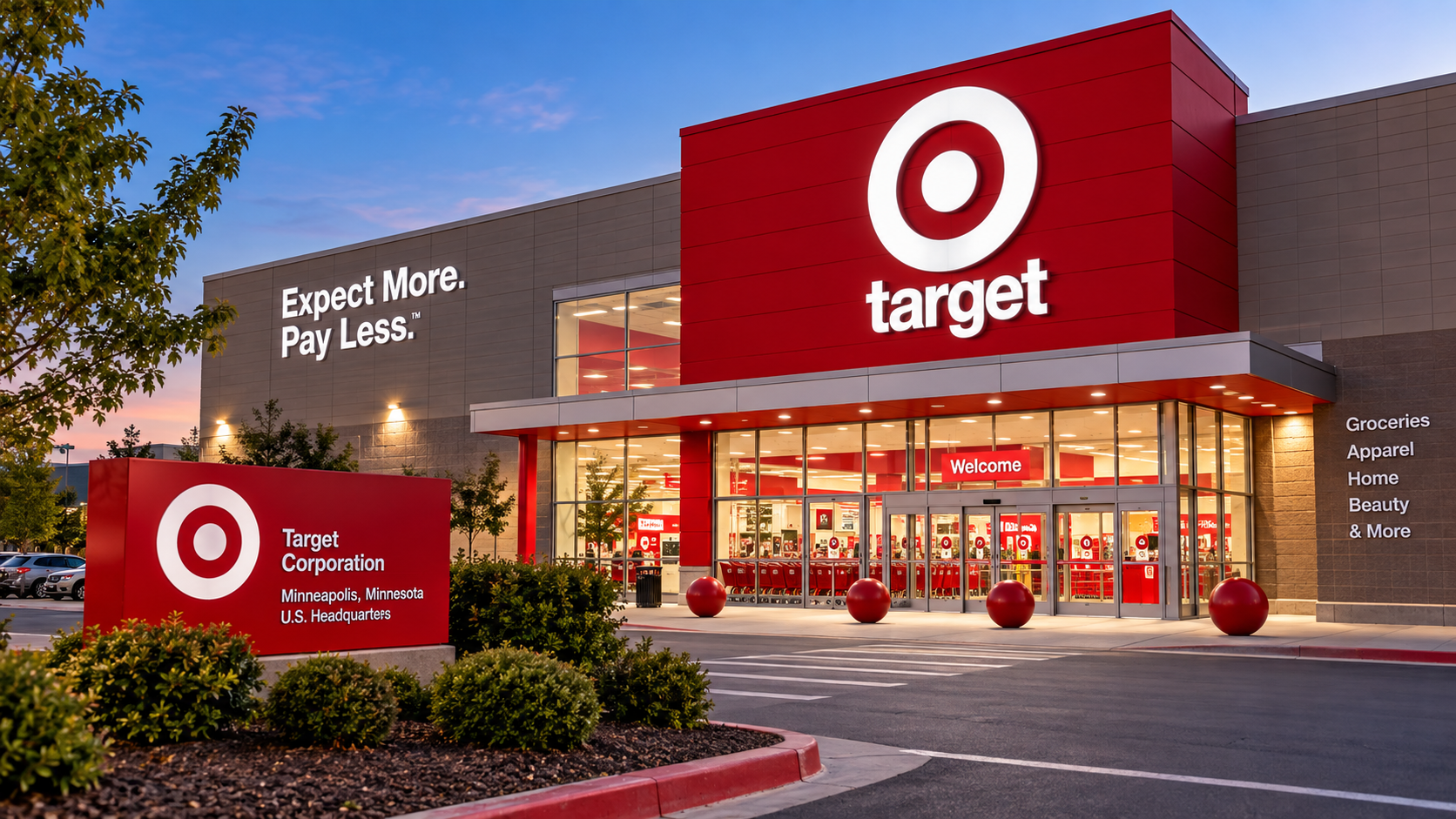
Target Corporation is one of the largest general merchandise retailers in the United States. Known for its red Bullseye logo, owned brands and combination of style, convenience and competitive pricing, Target serves customers through more than 2,000 U.S. stores and its digital shopping channels.
This Target Corporation company profile examines the company’s history, headquarters, leadership, products, business model, workforce and latest annual performance. Financial and employee figures use Target’s fiscal 2025 reporting, which ended on January 31, 2026. Figures from different reporting periods are clearly identified to avoid presenting historical information as current.
Target Corporation Company Profile at a Glance
| Company detail | Information |
|---|---|
| Official name | Target Corporation |
| Business type | Public retail corporation |
| Industry | General merchandise retail |
| Incorporated | 1902 in Minnesota |
| First Target store | Roseville, Minnesota, in 1962 |
| Headquarters | Minneapolis, Minnesota, United States |
| Chief executive officer | Michael Fiddelke |
| Stock exchange | New York Stock Exchange |
| Stock symbol | TGT |
| Operating structure | Single reportable business segment |
| U.S. stores | More than 2,000 |
| Supply-chain facilities | 66 |
| Employees | Approximately 415,000 |
| Fiscal 2025 net sales | $104.780 billion |
| Official shopping website | Target.com |
| Corporate website | Corporate.Target.com |
The store and location figures above reflect Target’s corporate locations page as checked in September 2026. The employee figure is reported as of January 31, 2026, while net sales cover the 52-week fiscal year that ended on the same date.
What Is Target Corporation?
Target Corporation is a publicly traded American retailer offering general merchandise and groceries through stores and online channels. Its product assortment includes food, clothing, beauty products, household essentials, electronics and home furnishings.
The company refers to its customers as “guests” and seeks to differentiate itself through design, style, value and a curated product selection. Target also combines national brands with owned and exclusive brands that customers may not find at competing retailers.
Target operates as a single reportable business segment. This means its consolidated reports generally present Target Corporation and its subsidiaries as one operating business rather than publishing separate financial results for multiple retail divisions.
Target Corporation and Target Australia Are Different Companies
Target Corporation does not own or operate Target Australia. Despite their similar names and branding, Target Australia is a separate and unrelated retail company.
This distinction matters when researching store counts, revenue, employees or customer policies. Information about Target Australia should not be included in a U.S. Target company overview unless the purpose is to explain the difference between the two businesses.
Target Corporation History
Target Corporation was incorporated in Minnesota in 1902, but the Target retail brand appeared several decades later. The first Target store opened in Roseville, Minnesota, on May 1, 1962.
The original retail idea combined department-store qualities such as fashion, service and attractive merchandise with discount pricing. By the end of 1962, additional Target locations had opened in Minnesota, providing the foundation for expansion into other U.S. markets.
Over time, Target developed into a nationwide retailer. The company reached all 50 states and the District of Columbia after opening its first Vermont store in 2018. Its stores now operate as both shopping destinations and local fulfilment hubs for digital orders.
Important milestones in Target Corporation’s history include:
- 1902: The corporation was incorporated in Minnesota.
- 1962: The first Target store opened in Roseville, Minnesota.
- 1978: Target began using its recognizable red shopping carts.
- 2018: Target reached all 50 states with its first Vermont store.
- 2026: Michael Fiddelke became chief executive officer.
These milestones show how Target developed from a regional discount-store concept into a large omnichannel retailer. Its history is closely connected to Minnesota, where the company continues to maintain its headquarters and corporate campuses.
Target Corporation Headquarters and Locations
Target Corporation is based in Minneapolis, Minnesota. The company lists two corporate campuses in Minneapolis and Brooklyn Park, along with additional offices elsewhere in the United States.
Its physical retail network includes more than 2,000 stores across the country. Target also reports 66 supply-chain facilities across 25 states, supported by a distribution workforce of nearly 60,000 people. These facilities help move merchandise to stores and customers.
Although Target’s retail stores are located in the United States, some business functions have an international presence. The company maintains a global capabilities centre in Bengaluru, India, as well as sourcing offices in multiple countries. These operations assist with technology, product development, sourcing and other corporate activities.
A company profile should therefore distinguish between Target’s U.S. retail market and its international support and sourcing presence. Target is primarily a U.S. retailer, but parts of its supply chain and corporate operations extend beyond the country.
Target Corporation Products and Services
Target sells a broad selection of everyday and discretionary products. Its assortment is organized across six core merchandise categories:
- Apparel and accessories
- Beauty
- Food and beverages
- Hardlines, including electronics and toys
- Home furnishings and décor
- Household essentials
Food and beverages represented the largest merchandise category in fiscal 2025, accounting for 24% of merchandise sales. Household essentials represented 18%, while apparel, hardlines, and home furnishings and décor each accounted for 15%.
Owned and Exclusive Brands
Approximately 30% of Target’s merchandise sales come from owned and exclusive brands. Well-known examples include Good & Gather, up & up, Cat & Jack, Threshold, A New Day and All in Motion.
These brands help Target differentiate its assortment and offer products at different price points. The company also works with external brands and uses shop-in-shop arrangements and creative partnerships to broaden the in-store experience.
Shopping and Fulfilment Services
Customers can purchase products inside Target stores or through the company’s website and mobile application. Depending on product and location availability, fulfilment options can include shipping, store pickup, Drive Up and same-day delivery.
Target’s stores are central to this system. In each of the three years through fiscal 2025, stores fulfilled more than 97% of merchandise sales, including purchases that began digitally. This makes the physical store network both a retail channel and a major fulfilment asset.
Target Corporation Business Model
Target’s business model is primarily based on purchasing merchandise from suppliers and selling it to customers at a markup. Most revenue comes from merchandise sales through physical stores and digital channels.
The company reported $102.717 billion in merchandise sales during fiscal 2025. Target also generated revenue from advertising, credit-card profit sharing, membership fees, marketplace activity and other sources.
Additional Revenue Sources
Roundel, Target’s advertising business, provides advertising services to brands, vendors and marketplace sellers. Target reported $915 million in advertising revenue for fiscal 2025, although some advertising-related amounts may be classified differently depending on the arrangement.
Target also receives profit-sharing income connected with Target Circle credit cards under its agreement with TD Bank Group. Other revenue sources include Target Plus marketplace activity, memberships, in-store arrangements and related services.
This model allows Target to earn revenue beyond traditional retail transactions. However, merchandise sales remain the foundation of the company’s overall business.
Target Corporation Management and Organizational Structure
Michael Fiddelke is the chief executive officer of Target Corporation. He assumed the position on February 1, 2026, after previously serving in senior roles within the company.
Target’s leadership team includes executives responsible for stores, supply chain, human resources, technology, finance, merchandising and stakeholder engagement. The board of directors provides governance and oversight of the corporation.
Target describes itself as operating through a single business segment. Internally, different functions manage important areas of the business, but the company reports consolidated financial results rather than separate segment revenue for each department.
Subsidiaries and capabilities support its wider operations. For example, Shipt contributes to same-day delivery services, while Roundel supports advertising activities. These operations form part of Target’s broader corporate structure even though the company reports them within its single operating segment.
Target Corporation Revenue and Financial Performance
Target reported net sales of $104.780 billion for fiscal 2025, the 52-week period that ended January 31, 2026. This was a decrease of approximately 1.7% compared with net sales of $106.566 billion in fiscal 2024.
Operating income declined from $5.566 billion in fiscal 2024 to $5.117 billion in fiscal 2025. Net earnings were $3.705 billion, compared with $4.091 billion in the previous fiscal year.
| Financial measure | Fiscal 2025 | Fiscal 2024 | Change |
|---|---|---|---|
| Net sales | $104.780 billion | $106.566 billion | Down 1.7% |
| Operating income | $5.117 billion | $5.566 billion | Down 8.1% |
| Net earnings | $3.705 billion | $4.091 billion | Down approximately 9.4% |
The figures indicate that operating income and net earnings declined faster than net sales. A fuller financial analysis should examine margins, comparable sales, merchandise categories and management’s explanation of cost pressures rather than judging performance from revenue alone.
Fiscal 2025 should not be confused with calendar year 2025. Target’s fiscal year ended on January 31, 2026, so both the fiscal period and ending date should be included whenever these figures are cited.
How Many Employees Does Target Corporation Employ?
Target Corporation reported approximately 415,000 full-time, part-time and seasonal employees as of January 31, 2026. The company calls its employees “team members.”
Employment levels change during the year because retail staffing typically increases during the holiday shopping season. Therefore, the reported employee count is a dated estimate rather than a live figure that remains constant throughout the year.
Independent contractors are not included in the same way as employees. Target notes that it also uses independent contractors, particularly within its Shipt subsidiary.
Anyone comparing Target Corporation employee count data across multiple years should check:
- The measurement date
- Whether seasonal employees are included
- Whether the number represents headcount or full-time equivalents
- Whether subsidiaries are included
- Whether the figure comes from Target or a third-party estimate
These checks prevent outdated or differently defined figures from being presented as directly comparable.
Target Corporation Customers and Market Position
Target serves a broad customer base across the United States. Its stores and digital platforms sell both necessities and discretionary products, allowing shoppers to purchase groceries, clothing, household goods and other items through one retailer.
The company’s value proposition combines competitive prices with design-focused products, owned brands and convenient shopping options. Target aims to offer an experience that feels more curated than a traditional discount store while remaining accessible to value-conscious customers.
Its large store network supports customer convenience and digital fulfilment. Target states that its stores are located within roughly 10 miles of most American doorsteps, which strengthens its ability to offer pickup and same-day fulfilment services.
Customer-service quality should be evaluated separately from the company’s stated strategy. Official pages can establish available services and policies, while properly sampled customer feedback can help identify recurring experiences or issues.
Target Corporation Competitors
Target operates in a highly competitive retail market. Its competitors vary by product category, price, shopping channel and customer need.
Major competitors include:
- Walmart: Competes across groceries, household essentials, apparel and general merchandise.
- Amazon: Competes strongly in e-commerce, delivery convenience and product variety.
- Costco: Competes through membership-based warehouse retail and value-focused bulk purchasing.
- Kroger and other grocery chains: Compete in food, beverages and household essentials.
- Department and specialty retailers: Compete with Target in areas such as apparel, beauty, electronics and home décor.
Target differentiates itself through owned brands, exclusive partnerships, design-led merchandise and the integration of stores with digital fulfilment. However, the importance of each competitor depends on the category being examined. Walmart may be the closest comparison for general merchandise and groceries, while Amazon is more relevant when analyzing online selection and delivery.
Target Corporation Strengths, Challenges, and Future Direction
Target’s major strengths include its recognizable brand, extensive U.S. store network, owned-brand portfolio and store-based fulfilment capabilities. Its assortment allows customers to combine essential purchases with fashion, beauty and home products in one shopping trip.
The company also faces strong competition, changing consumer spending patterns, merchandise risks and supply-chain pressures. Fiscal 2025’s decreases in net sales and operating income show why current performance should be evaluated alongside Target’s long-term brand strengths.
Under CEO Michael Fiddelke, Target has identified four broad strategic priorities:
- Strengthening merchandising authority
- Improving the guest experience
- Accelerating technology
- Supporting employees and communities
These priorities describe management’s intended direction rather than guaranteed future results. Future reports should compare the strategy with measurable outcomes such as comparable sales, digital growth, customer activity and operating margins.
Frequently Asked Questions
Who Owns Target Corporation?
Target Corporation is a publicly traded company owned by its shareholders. Its common stock trades on the New York Stock Exchange under the ticker symbol TGT.
Where Is Target Corporation Headquartered?
Target Corporation is headquartered in Minneapolis, Minnesota, United States. It also has a corporate campus in Brooklyn Park, Minnesota, and additional U.S. and international offices.
Who Is the CEO of Target Corporation?
Michael Fiddelke is the chief executive officer of Target Corporation. His appointment became effective on February 1, 2026.
How Many Stores Does Target Operate?
Target’s corporate locations page reports more than 2,000 stores in the United States. Because the company can open or close locations, the source and verification date should accompany the figure.
How Many Employees Does Target Corporation Employ?
Target employed approximately 415,000 full-time, part-time and seasonal team members as of January 31, 2026. This number may fluctuate because of seasonal hiring.
What Is Target Corporation’s Latest Annual Revenue?
Target reported net sales of $104.780 billion for fiscal 2025, which ended January 31, 2026. In company research, “net sales” is the more precise term for this reported figure.
Is Target Australia Owned by Target Corporation?
No. Target Australia is a separate business and is not owned or operated by the U.S.-based Target Corporation.
Conclusion
Target Corporation is a major U.S. retailer with more than 2,000 stores, a large digital operation and an extensive portfolio of national, owned and exclusive brands. Its store network supports both in-person shopping and digital fulfilment, while advertising, credit-card profit sharing and other services provide additional revenue.
This Target Corporation company profile shows that company information is most useful when every important figure includes its definition and reporting period. As of January 31, 2026, Target reported approximately 415,000 employees and fiscal-year net sales of $104.780 billion. These facts provide a strong overview, while separate analysis of Target’s business model, competitors, revenue trends and SWOT position can offer deeper insight.

1 Comment
Pingback: Target Corporation Company Analysis 2026