


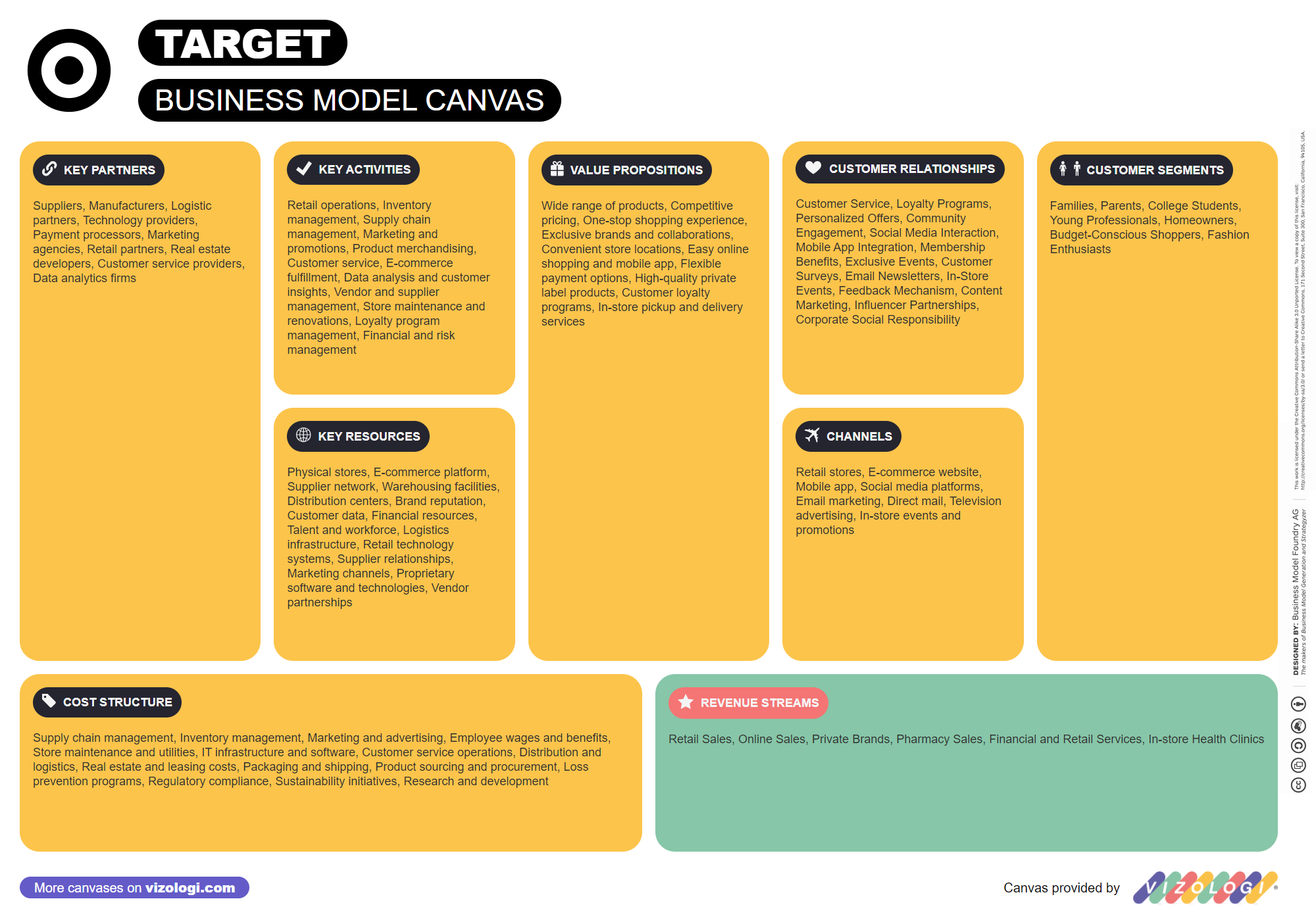
Target Corporation makes most of its money by selling merchandise through its physical stores and digital channels. The company also earns revenue from its Roundel advertising business, Target Circle 360 memberships, Target Plus marketplace commissions, credit-card profit sharing and other services.
In fiscal 2025, Target generated $104.780 billion in net sales, of which $102.717 billion came from merchandise. This means traditional retail sales remain the foundation of the Target Corporation business model, even as its digital and non-merchandise businesses continue to grow.
This guide explains how Target makes money, how stores support online sales, which product categories generate revenue and what costs and risks can affect profitability.
Target Corporation Business Model at a Glance
Target follows an omnichannel retail business model. It purchases products from suppliers, sells them to customers at a markup and uses its stores to support both in-person and digital shopping.
| Business-model component | How Target earns money |
|---|---|
| Merchandise sales | Sells food, apparel, beauty, home, electronics and household products |
| Owned brands | Sells Target-controlled brands such as Good & Gather and Cat & Jack |
| Roundel advertising | Provides advertising services to brands and marketplace sellers |
| Credit-card program | Receives a share of profits generated through eligible Target Circle cards |
| Target Circle 360 | Collects fees from its paid membership service |
| Target Plus marketplace | Earns commissions from third-party sellers |
| Shipt services | Earns membership and service revenue from same-day delivery |
| Other operations | Generates rental income and other miscellaneous revenue |
Target reports its operations as a single business segment. It therefore does not publish separate operating profit for every service shown above.
Target’s Primary Revenue Source: Merchandise Sales
Merchandise sales are Target Corporation’s largest source of revenue. The company buys products from vendors and sells them through more than 2,000 U.S. stores, Target.com and its mobile application.
For fiscal 2025, which ended January 31, 2026, Target reported:
| Revenue source | Fiscal 2025 revenue | Share of net sales |
|---|---|---|
| Merchandise sales | $102.717 billion | Approximately 98.0% |
| Advertising revenue | $915 million | Approximately 0.9% |
| Credit-card profit sharing | $522 million | Approximately 0.5% |
| Other revenue | $626 million | Approximately 0.6% |
| Total net sales | $104.780 billion | 100% |
Percentages are calculated from Target’s reported figures and are rounded. The table shows that non-merchandise activities are growing additions to the business but remain much smaller than product sales.
Target’s Main Product Categories
Target manages its merchandise across six primary categories:
- Food and beverages
- Household essentials
- Apparel and accessories
- Beauty
- Hardlines, including electronics and toys
- Home furnishings and décor
Food and beverages generated the largest share of fiscal 2025 merchandise sales at 24%. Household essentials accounted for 18%, while apparel, hardlines, and home furnishings and décor each contributed 15%. Beauty represented 13%.
This product mix combines frequently purchased essentials with discretionary products. Groceries and household goods can bring customers into stores regularly, while categories such as apparel, beauty and home décor may provide additional purchasing opportunities.
How Target Earns Profit from Retail Sales
Revenue is not the same as profit. Target must subtract the cost of merchandise, fulfilment, employee compensation, store operations, advertising, technology and other expenses from its net sales.
The company’s basic retail economics can be expressed as:
Selling price − merchandise and fulfilment costs − operating expenses = operating profit
Target reported $104.780 billion in fiscal 2025 net sales and $75.511 billion in cost of sales. After selling, general and administrative expenses and depreciation were included, operating income was $5.117 billion.
| Financial measure | Fiscal 2025 |
|---|---|
| Net sales | $104.780 billion |
| Cost of sales | $75.511 billion |
| Gross margin | 27.9% |
| Operating income | $5.117 billion |
| Operating margin | 4.9% |
| Net earnings | $3.705 billion |
Target can improve profitability by selling more products, securing better purchasing terms, reducing fulfilment costs or increasing higher-margin revenue. Profit can come under pressure when the company uses heavy markdowns, experiences inventory losses or faces higher import and operating costs.
The Role of Physical Stores in Target’s Business Model
Target stores are both sales locations and fulfilment centres. Customers can shop inside stores, collect online orders or receive products shipped and delivered from nearby Target locations.
Stores fulfilled more than 97% of Target’s merchandise sales in each of the three fiscal years through 2025. That includes store-originated purchases and digitally originated orders completed through pickup, Drive Up, shipment or same-day delivery.
This model can create several benefits:
- Inventory is located closer to customers.
- Existing stores support both physical and online sales.
- Customers can choose pickup, delivery or traditional shopping.
- Target may reduce its dependence on separate e-commerce warehouses.
- Store visits can create additional purchasing opportunities.
The same system requires accurate inventory records and well-managed store operations. If products are unavailable or digital orders are processed poorly, the problem can affect both online and in-store customer experiences.
How Target Makes Money from Digital Sales
Target does not treat online shopping as a completely separate business. Digital orders are closely integrated with stores and the company’s supply-chain network.
A sale is classified as digitally originated when it begins on Target’s website or mobile application. The order may then be shipped, collected through Order Pickup or Drive Up, or delivered through a same-day service.
Digitally originated merchandise sales increased from $19.4 billion in fiscal 2023 to $21.1 billion in fiscal 2025. During fiscal Q2 2026, Target reported an 8.7% increase in comparable digital sales, led by growth of more than 25% in same-day delivery.
Digital growth can generate additional sales and make Target more convenient. However, profitability depends on the fulfilment method, labour requirements, delivery costs and order size.
How Target’s Owned Brands Support Revenue
Target sells national brands alongside products developed under its owned and exclusive brands. These include Good & Gather, Cat & Jack, Threshold, up & up, A New Day and All in Motion.
Approximately 30% of Target’s merchandise sales come from owned and exclusive brands. These products support the business model in several ways:
- They make Target’s assortment more distinctive.
- They reduce direct product comparisons with competitors.
- They can encourage customers to return for products available only at Target.
- They give Target greater control over branding and product positioning.
- They may provide different margin opportunities than national brands.
Owned brands also carry additional responsibilities. Target must manage product development, sourcing, safety, inventory and customer demand. Incorrect forecasts can result in excess inventory and markdowns.
How Roundel Advertising Makes Money
Roundel is Target’s in-house retail media business. It provides advertising services to product vendors, agencies and Target Plus marketplace sellers.
Brands can use Roundel to promote products to relevant audiences across Target-owned and external digital channels. Target’s customer and shopping insights can help advertisers reach people who may be interested in particular products.
Target reported $915 million in advertising revenue during fiscal 2025, compared with $649 million in fiscal 2024. That represents an increase of approximately 41%, based on the reported figures.
Roundel can make Target’s customer relationships and digital traffic valuable beyond merchandise transactions. Its performance still depends on advertiser demand, customer engagement, technology partners and competition within digital advertising.
How Target Makes Money from Credit Cards
Target Circle Card offerings include debit cards, credit cards and a Mastercard. Cardholders can receive benefits such as an eligible 5% discount, extended returns and shipping benefits.
Target does not simply record all cardholder spending as credit-card revenue. Under its agreement with TD Bank Group, Target receives a percentage of profits generated by Target Circle credit-card receivables in exchange for account servicing and primary marketing activities.
TD Bank Group funds and owns the relevant receivables and oversees underwriting, risk management and regulatory compliance. Target reported $522 million in credit-card profit-sharing revenue during fiscal 2025.
The card program can also support merchandise sales by encouraging customers to shop at Target to use card benefits. However, the exact effect on shopping behaviour cannot be determined from profit-sharing revenue alone.
How Target Circle 360 Generates Membership Revenue
Target Circle 360 is the company’s paid membership program. It provides eligible benefits that include unlimited same-day delivery on qualifying orders over $35, free shipping and extended returns.
The program uses Target’s same-day delivery capabilities and Shipt’s marketplace. Members may order from Target and other participating retailers, subject to the service’s terms and availability.
Target earns money directly from membership fees. The service may also create indirect value by encouraging members to shop more frequently and use same-day delivery.
Target does not disclose Target Circle 360 as a separate annual revenue line in its fiscal 2025 financial statements. Membership revenue is included within “other” revenue alongside Shipt services, marketplace commissions, rental income and miscellaneous items.
In fiscal Q2 2026, Target reported that non-merchandise sales grew more than 20%, supported by Roundel advertising, Target Circle 360 membership revenue and the Target Plus marketplace.
How Target Plus Marketplace Makes Money
Target Plus is Target’s third-party digital marketplace. Approved outside sellers can offer products through Target’s online platform, expanding the assortment beyond merchandise directly owned by Target.
Target earns commissions on qualifying third-party sales. These commissions are included within the company’s “other” revenue category rather than merchandise sales.
The marketplace model allows Target to add products without purchasing and holding every item in its own inventory. It can increase customer choice and generate commission revenue, although Target must still manage seller standards, product quality and customer experience.
Target reported marketplace growth of more than 30% in fiscal Q4 2025. In fiscal Q2 2026, Target Plus was again identified as a contributor to more than 20% growth in non-merchandise sales.
How Shipt Supports Target’s Business Model
Shipt is a Target subsidiary that supports same-day delivery. Its personal shoppers fulfil eligible orders from Target and other participating retailers.
Target can earn Shipt membership and service revenue, which is included in the company’s “other” revenue category. Shipt also supports Target Circle 360 and strengthens Target’s ability to compete on delivery speed and convenience.
The subsidiary creates value beyond its directly reported revenue. Same-day delivery can make Target more useful for urgent purchases and may increase customer engagement. However, delivery economics depend on order size, labour, fulfilment efficiency and membership use.
Target’s Customer Loyalty Strategy
Target Circle is the company’s wider customer loyalty program. It includes a free membership tier, Target Circle Card benefits and the paid Target Circle 360 service.
The loyalty system supports Target’s business model by:
- Offering deals and personalized promotions.
- Encouraging repeat purchases.
- Connecting customers with Target’s digital channels.
- Promoting Target Circle cards and paid membership.
- Providing data that can support relevant advertising.
Loyalty programs can increase customer engagement, but discounts and rewards also create costs. The business benefit depends on whether additional spending and retention outweigh those expenses.
Target’s Main Business Costs
Target’s revenue must support a large physical and digital operation. Important costs include:
- Purchasing merchandise from suppliers.
- Freight, tariffs and import expenses.
- Operating stores and supply-chain facilities.
- Employee wages and benefits.
- Shipping and same-day fulfilment.
- Technology and cybersecurity.
- Advertising and administration.
- Product markdowns and inventory shrink.
- New stores, renovations and capital projects.
Target reported $75.511 billion in fiscal 2025 cost of sales. This included merchandise costs and supply-chain and digital-fulfilment expenses. Selling, general and administrative expenses were $21.535 billion.
The company’s profitability therefore depends on more than sales growth. Product mix, purchasing costs, markdowns, delivery expenses and operational efficiency can all affect margins.
Strengths of Target Corporation’s Business Model
Multiple Shopping Channels
Target combines stores, online ordering, pickup and delivery. Customers can choose the channel that best suits a particular purchase.
Strong Owned-Brand Portfolio
Owned and exclusive brands differentiate Target’s assortment and can build customer loyalty around products unavailable elsewhere.
Stores as Fulfilment Hubs
Using stores to fulfil digital orders allows Target to place products close to customers and use existing locations in multiple ways.
Diversifying Non-Merchandise Revenue
Roundel, Target Circle 360 and Target Plus add revenue streams beyond retail markups. Their recent growth could gradually improve the company’s revenue mix.
Broad Product Assortment
Target sells both essentials and discretionary products. This creates frequent shopping occasions and opportunities for customers to buy across categories.
Risks and Limitations of Target’s Business Model
Dependence on Merchandise Sales
Approximately 98% of fiscal 2025 net sales came from merchandise. Target remains highly exposed to consumer spending and retail competition.
Inventory and Markdown Risk
Incorrect demand forecasts can create product shortages or excess inventory. Unsold merchandise may need to be discounted, reducing profit margins.
Seasonal Dependence
The holiday period produces a larger share of Target’s annual sales. Poor execution or weak demand during important shopping seasons can have an outsized effect on annual results.
Supply-Chain and Tariff Exposure
Approximately half of the merchandise Target offers is sourced outside the United States. This creates exposure to tariffs, shipping disruption and changes in trade policy.
Intense Competition
Target competes with Walmart, Amazon, Costco, grocery chains and specialist retailers. Customers can quickly compare prices, availability and delivery options online.
Frequently Asked Questions
What Is Target Corporation’s Main Source of Income?
Merchandise sales are Target’s main source of income. They generated $102.717 billion of the company’s $104.780 billion in fiscal 2025 net sales.
Does Target Make Money from Advertising?
Yes. Target operates the Roundel retail media business and reported $915 million in advertising revenue for fiscal 2025.
Does Target Make Money from Its Credit Cards?
Target receives a share of profits generated from eligible Target Circle credit-card receivables under its agreement with TD Bank Group. The company reported $522 million in credit-card profit-sharing revenue in fiscal 2025.
How Does Target Circle 360 Make Money?
Target Circle 360 generates paid membership revenue. It can also support additional purchases by providing members with same-day delivery and other shopping benefits.
How Does Target Plus Generate Revenue?
Target earns commissions when approved third-party sellers make sales through its Target Plus marketplace. These commissions are included within other revenue.
Are Target’s Stores Still Important to Its Business Model?
Yes. Stores generate in-person sales and fulfil most digitally originated purchases. Target reported that stores fulfilled more than 97% of merchandise sales in each of the three years through fiscal 2025.
Conclusion
Target Corporation makes money primarily by selling merchandise through its stores and digital channels. Fiscal 2025 merchandise sales reached $102.717 billion, representing approximately 98% of total net sales.
The company is also developing additional revenue streams through Roundel advertising, credit-card profit sharing, Target Circle 360 memberships, Target Plus commissions and Shipt services. These activities remain smaller than retail sales but have recently grown faster.
The central strength of the Target Corporation business model is the connection between its extensive store network, owned brands and digital fulfilment services. Its long-term profitability will depend on maintaining customer demand, managing inventory and costs, and growing newer revenue sources without weakening the core shopping experience.
